Wednesday, April 3, 2013

Radian and Degree measure

hi guys this is John Luis A. Dalog and im doing a blog on degree and radian measure from monday's lesson

*π is equivalent to 180°* 

To convert the degree to radians, multiply the degree to π/180° 

examples:  
convert 30° to radian
=30°x π/180
=divide: 180/30 = π/6

convert 45° to radian

=45°x π/180°
=divide 180/45= π/4° 


  • Convert 270° to radians.
  • Since 180° equates to π, then:
      (270/1)*(pi/180) = (3/1)*(pi/2) = (3pi)/2
    The equivalent angle is  (3pi)/2


    to convert radian to degree, use 
      180°/
    π
     

examples:

convert 5π/6 to degrees
= 180/6=30
= 30x5=150°


Convert  pi/6  radians to degrees.

      (pi/6)*(180/pi) = (1/1)*(30/1) = 30
    The equivalent angle is 30°
Example 1:
Convert 60° to radian measure.
Example 2:
Convert 150° to radian measure.


 Exact radiansApproximate radians
30°0.52
45°0.785
60°1.048
90°1.57
180°3.142
270°4.71
360°6.28


http://www.mathopenref.com/radians.html
http://www.themathpage.com/atrig/radian-measure.htm
http://www.algebralab.org/lessons/lesson.aspx?file=trigonometry_trigdegradian.xml
http://hotmath.com/hotmath_help/topics/degree-to-radian-measure.html

there is lots of Example

Wednesday, March 27, 2013

Graphs of Polynomial Functions

Hello everyone,

Rowell here and I guess its my turn to blog but I don't think I can make a long blog so here are some links that should help,


(click the text)
Graphs of Polynomial Functions

Multiplicity and Zeros

Analyzing Graphs of Polynomial Functions

hope this somewhat helps..

Rowell


Wednesday, March 20, 2013

Characteristics of YOUR Polynomial Function!


Alyza Umali, at your service!
    Today, i will be reviewing the characteristics of a given polynomial function. This took me about 30 minutes to do, but it was worth it! I felt as though constructing this blog will help me understand the lesson more by trying to teach it to someone else :)


 First off, lets review what we know:
Degree
    - It is known as the highest degree of its terms, meaning the highest x power (eg. x8)
        ex) f(x)=x8 + 6x7 +4x2  
              =>
The highest degree is 8, therefore known as an "eighth degree polynomial"
Leading Coefficient
    - The coefficient with the highest degree in the term.
    - y = -2x3 + 6x- 4 (Negative = -2)
    - y = 3x3- 4x2 -5x +2 (Positive = 3) 
Naming Functions         
Constant Function
No x-intercept   
Linear Function    
  1 x-intercept
 Quadratic Function
 2 x-intercepts
Cubic Function
3 x-intercepts
Quartic Function
4 x-intercepts
Quintic Function
5 x-intercepts
End Behaviour
    - The quadrants in where the polynomial starts and ends.
     Quadrant I = + X & +Y
     Quadrant II = -X & +Y
     Quadrant III = -X & -Y
     Quadrant IV = +X & -Y


ex) Rules in Graphing Polynomials: 
EVEN Degree Polynomials
Positive Leading Coefficient
(eg. x2) Open upward

Negative Leading Coefficient
(eg. -2x2) Open downward


ODD Degree Polynomials
Positive Leading Coefficient
Starts/Ends Quadrant II & IV


Negative Leading Coefficent
Starts/Ends Quadrant I & III


X-intercepts (Zeros)
     - The points on a graph in where the function crosses the x-axis.
ex) y = (x+2)(x+1)(x-1)(x-2)
     Your x-intercepts would be: -2, -1, 1, & 2.


* NOTE -
    Unique Roots - Curve crosses x-axis 1 time !


   Same Roots - This is also known as the Multiplicity of a Zero
                        - Even # of roots - Bounces off the x-axis!
                        - Odd # of roots - Becomes flatter!

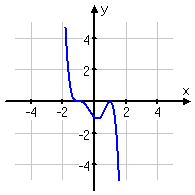
  ex) The graph shows an even root that is a "Multiplicity of 2 at -4"


ex) The graph shows an odd root that is a "Multiplicity of 3 at -3"


Relative Minimum/Maximum
    - Cubic Functions have neither a minimum or maximum, but they DO have a RELATIVE minimum or RELATIVE maximum.


Absolute Minimum/Maximum
    - Quartic functions can have both relative and absolute minimum and maximum.

Determining Intervals when function is Positive or Negative.
    - Parts of the function that are below the x-axis are negative, and the other parts of the function that cross over the x-axis are positive.


Now to ponder!
    When looking at a polynomial equation and you must draw a function on a graph, first thing is to ask  
    yourself:
    - What is the Degree?
    - Is the sign of the Leading Coefficient Positive? or Negative?
    - Where does my end behaviour start and end?
    - What is/are my x-intercept(s)?
    - What is my y-intercept?
    - Does it have any unique or same roots? If so, Odd? or Even?
Always read the question carefully and BE CONFIDENT IN YOUR ANSWER!

Now that you have an idea of most of the characteristics and rules for a polynomial function, you are now able to analyze majority of any polynomial function and be able to graph it! Good luck this semester everyone! God Bless! (:

Monday, March 18, 2013

Graphing Polynomial functions


Hello everyone!

I am Davinder Partola. I will be doing the post for today which will be basically on Introducing graphing polynomial functions since my friends pretty much covered everyhting else we did  in their posts.

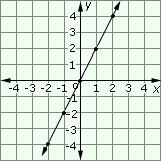
Basically we are Covering degrees up to 5 in our precal class.which are:

0=     constant , 1=     Linear ,  2=    Quaderatic, 3=     Cubic,  4=     Quartic  and 5 =       Quintic                   

When you're graphing (or looking at a graph of) polynomials, it can help to already have an idea of what basic polynomial shapes look like.

Steps involved in graphing polynomial functions:


  1. Predict the end behavior of the function.
  2. Find the real zeros of the function. Check whether it is possible to rewrite the function in factored form to find the zeros. Otherwise, use Descartes rule of signs to identify the possible number of real zeros.
  3. Make a table of values to find several points.
  4. Plot the points and draw a smooth continuous curve to connect the points.
  5. Make sure that the graph follows the end behavior as found in the above step.


 One of the aspects of this is "end behavior", and it's pretty easy.
 Main aspects to remember are:
                                odd degrees     if positive:  expands from quadarant 3 to quaderant  1

                                                         if negitive:   expands from quaderant 4 to 2
                                even degrees   if positive:    expands from quaderant 2 to 1
                                                         if negitive:    expands from quaderant 3 to 4

figure


The y intercept is when x = 0.  Also where the line drawn touches the graph on y axis

The x intercept is  when y = 0."x-intercepts" = "roots" = "solutions" = "zeroes"


For this example the x intercept would be -5,2,4

Example:
Graph the polynomial function x3 – 2x2 – 3x .
Predict the end behavior of the function.
The degree of the polynomial function is odd and the leading coefficient is positive.

The degree of the polynomial is 3 and there would be 3 zeros for the functions.
The function can be factored as x ( x + 1)( x – 3). So, the zeros of the functions are x = –1, 0 and 3.
Make a table of values to find several points.

Plot the points and draw a smooth continuous curve to connect the points


I wish this kind of helped you learning some concepts. But if you still dont get it: PRACTICE Because practice makes everyone perfect.
sources:
http://hotmath.com/hotmath_help/topics/graphing-polynomial-functions.html

and 

My brain (Oh Yeah)


Sunday, March 17, 2013

Remainder theorem, Factor theorem, and Rational root theorem

Hi everyone, it's Amina and this blog is about our lesson on remainder theorem, factor theorem, and rational root theorem.

Remainder Theorem:
The Remainder Theorem is useful for evaluating polynomials at a given value of x.
The Remainder Theorem starts with an unnamed polynomial p(x), where "p(x)" that means "some polynomial p whose variable is x". Then dividing that polynomial by a linear factor x – a, where a is just some number. As a result of the synthetic division, you end up with some polynomial answer q(x) (the "q" standing for "the quotient polynomial") and some polynomial remainder r(x).

Example:
p(x) = x3 – 7x – 6 and divide be x-4( so a =4)  

completed division:  bottom row: 1  4  9  30


 We get a quotient of q(x) = x2 + 4x + 9 , with a remainder of r(x) = 30.

If   p(x) / (x – a)  =  q(x)  with remainder  r(x),
then  p(x)  =  (x – a) q(x)  +  r(x).

Since  (x^3 – 7x – 6) / (x – 4)   =   x2 + 4x + 9   with remainder 30,   
 then   x3 – 7x – 6  =   (x – 4) (x2 + 4x + 9)  +  30.

Another way to get the remainder  is we replace x with 4.
 p(4) = (4 – 4)((4)2 + 4(4) + 9) + 30        = (0)(16 + 16 + 9) + 30        = 0 + 30        = 30

Factor Theorem: 

 The factor theorem is a theorem commonly applied to factorizing and finding the roots of polynomial equations. If P(x), a polynomial in x is divided by x - a and the remainder is zero, then (x - a) is a factor of P(x)

Example:
Is x - 2 is a factor of x2 - 7x + 10.

Let P(x) = x2 - 7x + 10
By the factor theorem, x - 2 is the factor of P(x) if P(2) = 0.

P(x) = x2 - 7x + 10
P(2) = 22 - 7 * 2 + 10 (Substitute x = 2)
= 4 - 14 + 10
= 0
Since P(2) = 0  => x - 2 is a factor of P(x).

Rational Root Theorem:

Steps to solving rational root theorem questions:

  1. Arrange the polynomial in descending order
  2. Write down all the factors of the constant term. These are all the possible values of p .
  3. Write down all the factors of the leading coefficient. These are all the possible values of q .
  4. Write down all the possible values of . Remember that since factors can be negative, and - must both be included. Simplify each value and cross out any duplicates.
     5.Use synthetic division to determine the values of for which P() = 0 . These are all the rational roots of P(x) . 

Example:

  1. P(x) = 2x 4 + x 3 -19x 2 - 9x + 9
  2. Factors of constant term: ±1 , ±3 , ±9 .
  3. Factors of leading coefficient: ±1 , ±2 .
  4. Possible values of : ± , ± , ± , ± , ± , ± . These can be simplified to: ±1 , ± , ±3 , ± , ±9 , ± .
  5. Use synthetic division:

Thus, the rational roots of P(x) are x = - 3 , -1 , , and 3 .

Sources:
 http://www.purplemath.com/modules/remaindr.htm
 http://math.tutorvista.com/algebra/factor-theorem.html
 http://www.sparknotes.com/math/algebra2/polynomials/section4.rhtml